
Core Function and Structure Analysis of OTC Daihen Collision Sensor SSB (Shock Sensor)
In the OTC DAIHEN industrial welding robot system, collision sensors are mainly divided into two series models: SSV and SSB. They are commonly known as “anti-collision boxes”, and are the core safety hub installed between the robot’s sixth axis (J6 flange) and the welding torch body.
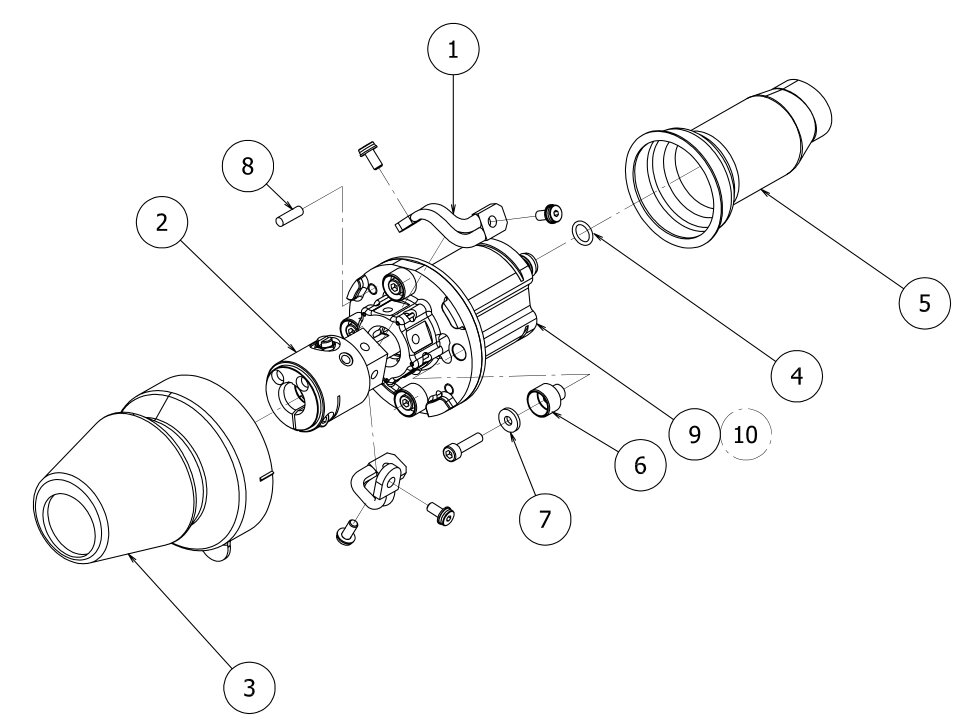
In complex automated arc welding working conditions, accidental physical interference between the welding torch and workpieces or fixtures is highly prone to occur. The SSB type collision sensor integrates a highly sensitive spring return mechanism and a micro-switch signal loop internally. Once the welding torch suffers an abnormal external impact, the SSB sensor will instantaneously undergo physical deflection, cutting off the internal safety signal (triggering the control cabinet’s A5016 Collision Action alarm), forcing the robot’s servo motors to execute an emergency braking stop within milliseconds, thereby greatly protecting the expensive robot reducer and welding torch barrel. Below is the original parts exploded view and official model reference for the SSB type sensor:
Figure 1: Original Internal Structure Exploded View of OTC Daihen Collision Sensor SSB
II. Detailed Model Reference Table for Original Parts of Collision Sensor SSB
Please carefully check the corresponding number sequence in the exploded view above. This data table adopts a high-definition solid line and alternating zebra stripe design with a rigorous structure, ensuring that maintenance personnel can accurately look up and procure the required seals and hardware mechanisms:
| Image No. | Official Ordering Model | Standard Accessory Name | Functional Note and Maintenance Instructions |
|---|---|---|---|
| ① | L10601D00 | Wire Feed Cable (Internal Short Cable) | Dedicated wire feeding flexible conduit connecting the front end of the welding torch. |
| ② | L10601C00 | Nozzle Support Assembly (Fixing Base) | Core metal component used to clamp and fix the welding torch neck. |
| ③ | L10601B10 | Fairing (Dust Protection Cover) | Metal/resin shield blocking welding spatter and fumes from intruding inside the sensor. |
| ④ | 3574-017 | O-Ring (Sealing Rubber Ring) | Extremely vulnerable part that prevents shielding gas leakage and cushions mechanical impacts. |
| ⑤ | L10601B13 | Control Cable Sleeve | Anti-breakage flexible sleeve protecting the tiny signal wires of the internal micro-switch. |
| ⑥ | L10601B09 | Insulator (Anti-Leakage Part) | Core insulating assembly isolating high-frequency welding currents. |
| ⑦ | 100-0650 | Washer | Cushioning metal washer assembled to prevent loosening. |
| ⑧ | 100-0651 | Insulating Shaft | Core insulating mechanical support shaft, preventing strong current creepage. |
| ⑨ | L10601B00 | Collision Sensor (Core Main Body) | The SSB sensor assembly containing the spring mechanism and micro-switch. |
| ⑩ | L10771B00 | Insulating Connecting Flange Cover (Unnamed) | Isolation protection piece that blocks strong welding torch current from conducting to the robot body. |
Collision Sensor (SSB) Workshop Frontline Maintenance and Impact Troubleshooting Core Standards:
- Aging and leakage hidden danger of O-ring (3574-017): The O-ring inside the sensor not only plays a role in mechanical buffering but, more importantly, it seals the gas chamber for the welding shielding gas. Due to long-term exposure to high-temperature arc radiation, the O-ring is prone to hardening and carbonization cracking. Once damaged, shielding gas will leak massively inside the sensor, resulting in weak gas flow reaching the contact tip, triggering dense oxidation gas pores in the weld seam. It is recommended to perform a soap water leak check every half year and periodically replace the original O-ring.
- Physical reset after a severe collision: When the robot collides and pops up the
A5016 (Collision Action)alarm, it is strictly prohibited to immediately force an alarm reset and continue operation. Operators must enter the safety area, manually shake the lower part of the collision sensor gently, and check whether the internal spring returns smoothly and whether it is jammed. If the entire sensor is found to be tilted and unable to spring back, it means the internal central axis has been strongly bent, and the entireL10601B00main body must be replaced to prevent jamming and loss of protective function. - Anti-creepage cleaning of insulation assemblies (L10601B09 / 100-0651): There are multiple insulating parts between the SSB sensor and the robot’s sixth-axis flange. If a large amount of conductive metal dust accumulates around the insulating shaft or insulator over a long period, it is highly likely to cause the high-voltage welding potential on the welding wire to reversely creep to the robot’s metal casing, instantaneously burning out the precision encoders inside the robot. Be sure to use dry compressed air to thoroughly blow out the dead-corner dust inside the sensor gaps during daily inspections.
️ Fast Access to Spot Quotes and Tech Support for Complete Set of SSB Collision Sensor Parts
The collision sensor is the last line of defense protecting the robot from devastating physical damage, and the sensitivity of its internal micro-switch and the insulation impedance are directly related to the lifespan of the expensive robot. Whether you need to separately purchase aging O-ring seals, control cable sleeves, or require a complete quick replacement of the L10601B00 sensor assembly, you are welcome to provide your component sequence number or model. Contact us directly to obtain the latest official standard factory quotes and today’s spot direct delivery service: